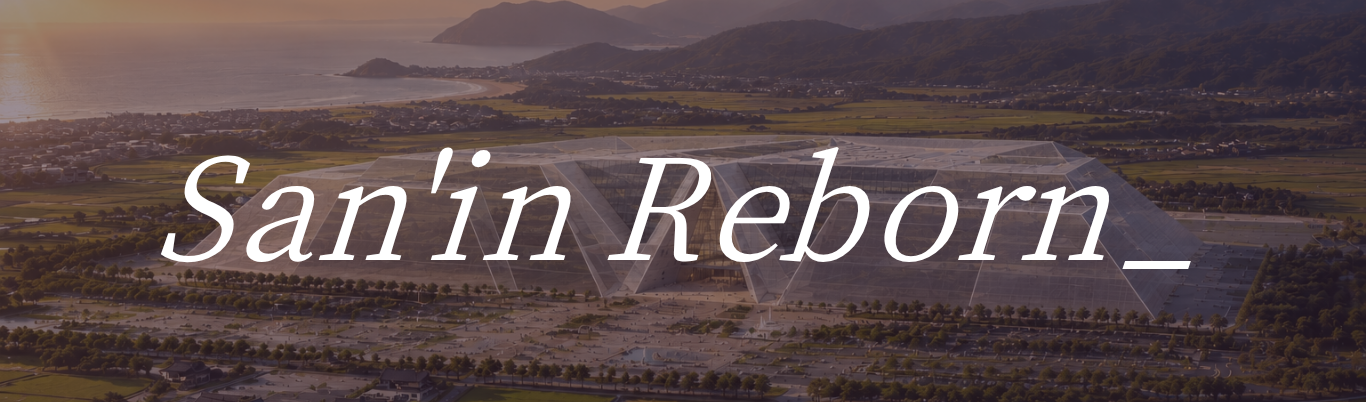
San'in Reborn_
What if one of Japan's most overlooked regions became a place to rediscover the ancient world?
Why San'in?
San'in is often associated with Japanese mythology. Yet beneath that image lies a remarkable concentration of archaeological sites, ancient cultural remains, and vast rural landscapes.
More Than Mythology
Ancient burial mounds, bronze ritual objects, settlements and sacred places reveal a much deeper history of San'in.
Space for Something Big
With a relatively small population and vast areas of rural land, San'in offers something major cities cannot easily provide: space.
A Landscape of the Ancient World
Sand dunes, mountains, the Sea of Japan, ancient shrines and archaeological sites create a landscape with a strong sense of the distant past.
The Museum
National Museum of Ancient Civilizations
A concept for a large-scale museum dedicated
to the civilizations of the ancient world,
imagined in the rural landscape of San'in, Japan.
Ancient Near East
Egypt, Mesopotamia, Persia and the ancient civilizations of the Near East.
Ancient Europe
Greece, Rome, the Mediterranean, and the ancient cultures of Europe.
Ancient Asia & the Silk Road
China, Korea, India, Central Asia, and the many cultures connected by the Silk Road.
Ancient Japan
Jōmon, Yayoi, Kofun, Asuka, Nara, Heian, and the archaeological heritage of ancient Japan.
Related Project
Ancient San'in Historic District
San'in is home to a remarkable collection
of archaeological and cultural sites connected
to the ancient history of Japan.
Ancient Heritage, Seen as One Landscape
From bronze ritual objects and burial mounds to ancient settlements and sacred places, these sites tell the story of how ancient culture developed in Japan.
What if they were connected?
What if these scattered remains could be viewed as one historic landscape — a place where the development of ancient Japanese culture can be experienced as a whole?
Here, there is room to be reborn.